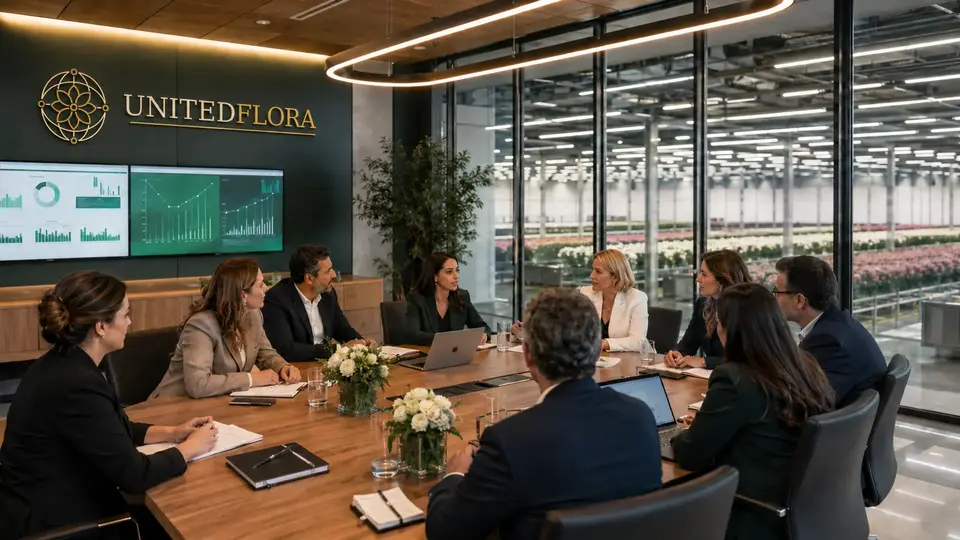
Production reserved for your brand. Infrastructure operated by UNITEDFLORA.
The 25,000 m² gross partner unit is designed as a standard production block connecting four controlled growing halls, young-plant transition, harvest and packing, cold chain and technical infrastructure through one directional flow built around an accepted demand plan.
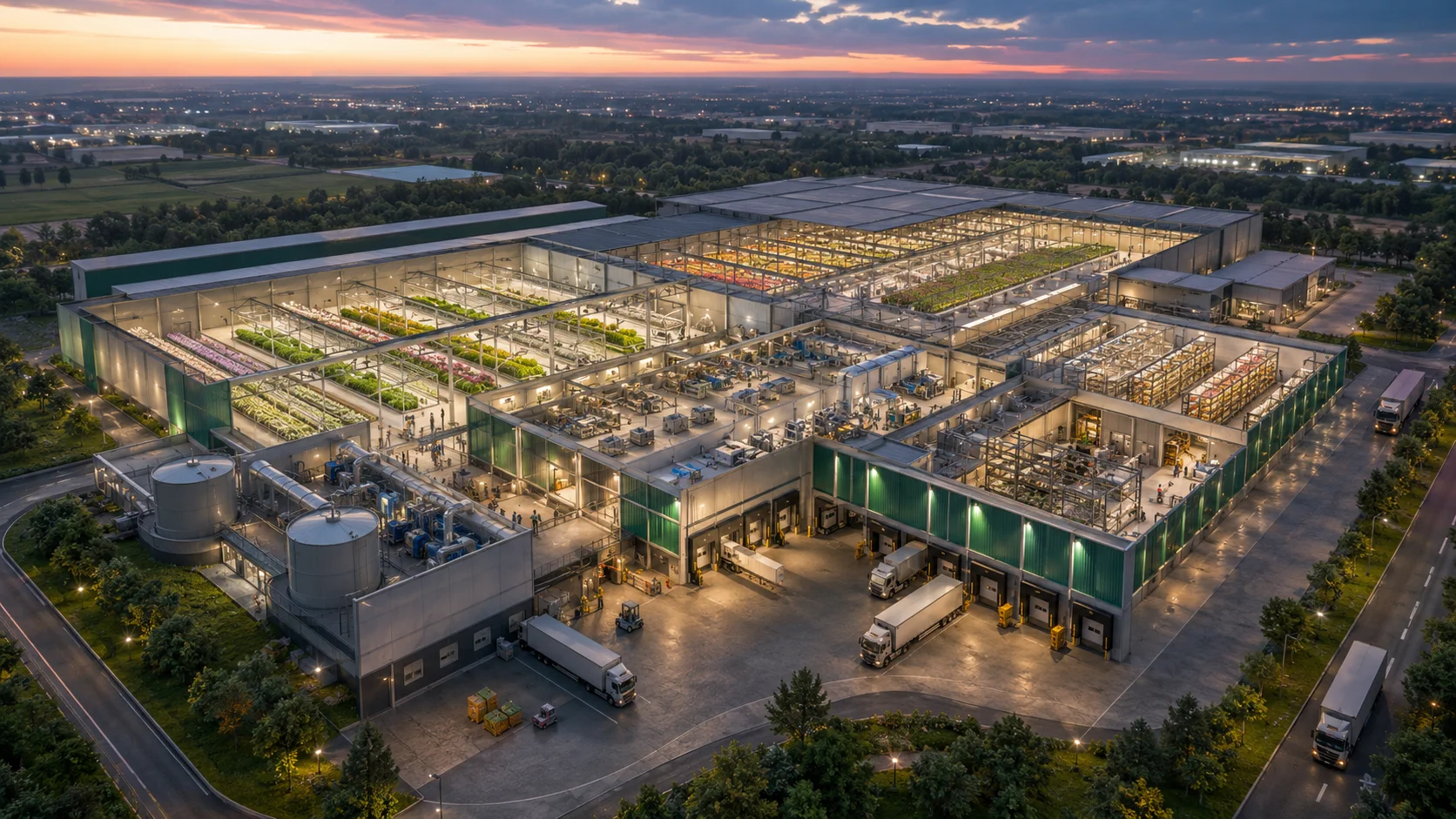
Growing halls on both sides. A clean processing spine at the centre.
The 250 × 100 metre reference envelope connects controlled-production compartments on both sides to a clean processing and technical-service spine at the centre. Main production is divided into four independent halls, supported by propagation, early-growth and finishing areas.
AGrowing hall A2,875 m²
BGrowing hall B2,875 m²
HPostharvest & outbound2,250 m²
IInbound & service1,250 m²
UPlant & controls2,250 m²
QQA & trials500 m²
PPeople & administration750 m²
SShared circulation2,500 m²
CGrowing hall C2,875 m²
DGrowing hall D2,875 m²
MMother stock & propagation1,250 m²
NNursery & early growth1,750 m²
FFinishing buffer1,000 m²
25,000 m² gross-area allocation
| Programme | Area | Share |
|---|---|---|
| Controlled production programme | 15,500 m² | 62% |
| Postharvest and outbound | 2,250 m² | 9% |
| Inbound and service logistics | 1,250 m² | 5% |
| Building plant, energy and controls | 2,250 m² | 9% |
| Quality and recipe trials | 500 m² | 2% |
| People and administration | 750 m² | 3% |
| Shared circulation, airlocks and structure | 2,500 m² | 10% |
| TOTAL | 25,000 m² | 100% |
Areas are a gross internal concept programme; external roads, parking, truck aprons, open utility yards and landscaping are excluded. Structural grid, fire egress, loading geometry, local code, MEP and crop protocol may rebalance the programme during final design.
One connected chain from biological input to partner-branded dispatch.
Demand and crop brief
Product standard, volume, target market and delivery calendar are defined together.
Intake and quarantine
Biological material is identified by lot, inspected, quarantined and released into the clean production flow.
Controlled growing
Climate, light, water and nutrition, and lot data follow the crop recipe.
Harvest and packing
Product is graded, checked against quality criteria and packed to partner standard.
Cold chain
Pre-cooling, short-term storage and dispatch preparation follow the crop programme.
Controlled delivery
Traceable lots leave under the partner brand and approved delivery plan.
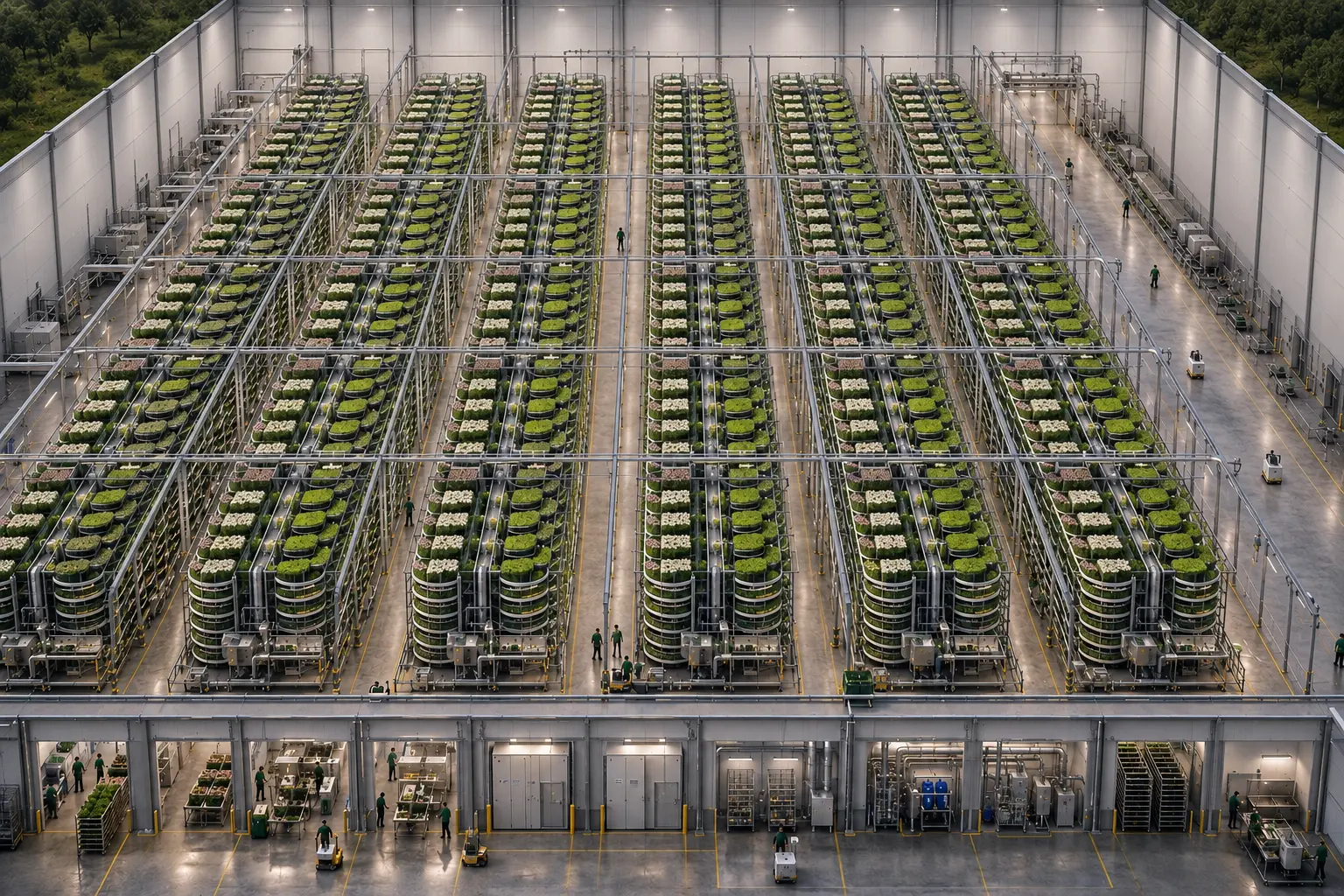
Every partner programme operates with separated data, recipes and quality criteria.
Zoned climate
Hall-level temperature, humidity, airflow and photoperiod control.
Crop-specific light
Spectrum, PPFD, DLI and lighting duration by growth stage.
Water and nutrition
EC, pH, water temperature, recipe, recovery and hygiene oversight.
Lot traceability
Recipe, lot, cycle and quality records from genetics to dispatch.
Biosecurity zoning
Quarantine, hygiene barriers and separated clean and dirty material routes.
Automation-ready flow
Continuous material flow and production automation for validated crops.
The partner unit is designed for scalable, high-volume and continuous production.
Four independent growing halls support separated crop programmes, balanced year-round production and phased capacity expansion in line with partner demand.
The same crop objective—with a different risk and control profile.
Greenhouse production benefits from natural light but remains more closely linked to outdoor conditions. The UNITEDFLORA controlled-indoor model is designed to manage the growing environment inside the building, improving continuity, standardisation and planning reliability.
| Assessment | Conventional greenhouse | UNITEDFLORA controlled indoor |
|---|---|---|
| Climate and seasonality | More exposed to changes in outdoor temperature, solar radiation and season. | Temperature, humidity, airflow and photoperiod are managed against the crop recipe. |
| Production continuity | Season and weather can introduce variation into the production plan. | Plannable year-round cycles and a more balanced delivery calendar are targeted. |
| Space utilisation | Production generally relies on a single growing plane. | Vertical volume use supports greater production intensity within the same building footprint. |
| Water and nutrition | Recovery is possible; performance varies with greenhouse infrastructure and climate. | Measurement, precision dosing and recovery strengthen resource management. |
| Biosecurity | Ventilation openings and the outside environment can increase pest pressure. | Zoning, hygiene barriers and controlled entry reduce external exposure. |
| Quality standard | Variation in natural light and climate can create differences between batches. | Repeatable climate and lighting recipes support more consistent quality. |
| Energy profile | Uses sunlight; heating and cooling loads vary by climate. | May use more electricity for lighting and climate in return for control and predictability. |
Core partner advantages of the UNITEDFLORA model
Predictable contract production
Volume, quality level and delivery window are managed against the accepted demand plan.
Year-round market continuity
The model targets a more balanced product flow with reduced seasonal variability.
Standard quality and traceability
Crop recipes, lot data and quality controls are recorded from genetics to dispatch.
Modular capacity growth
New volume can be added through independent units as partner demand and technical validation progress.
This is a qualitative concept comparison. Energy use, water efficiency, crop duration, investment and unit-cost outcomes require separate validation for the crop, local climate, energy tariff and approved engineering design.
Two partner units can form a 50,000 m² phase block.
The standard 25,000 m² unit can be replicated independently or in pairs along the same main-campus backbone as demand contracts and technical validation progress.
25,000M² · PARTNER UNIT 01
+25,000M² · PARTNER UNIT 02
=50,000M² · PHASE BLOCK
Let us define the production programme for your brand.
Share the crop group, target market, annual volume and quality standard so fit, production planning and capacity planning can be assessed together.
Start a production requestImages, plans and dimensions are concept-level only and do not represent a final project or performance commitment.